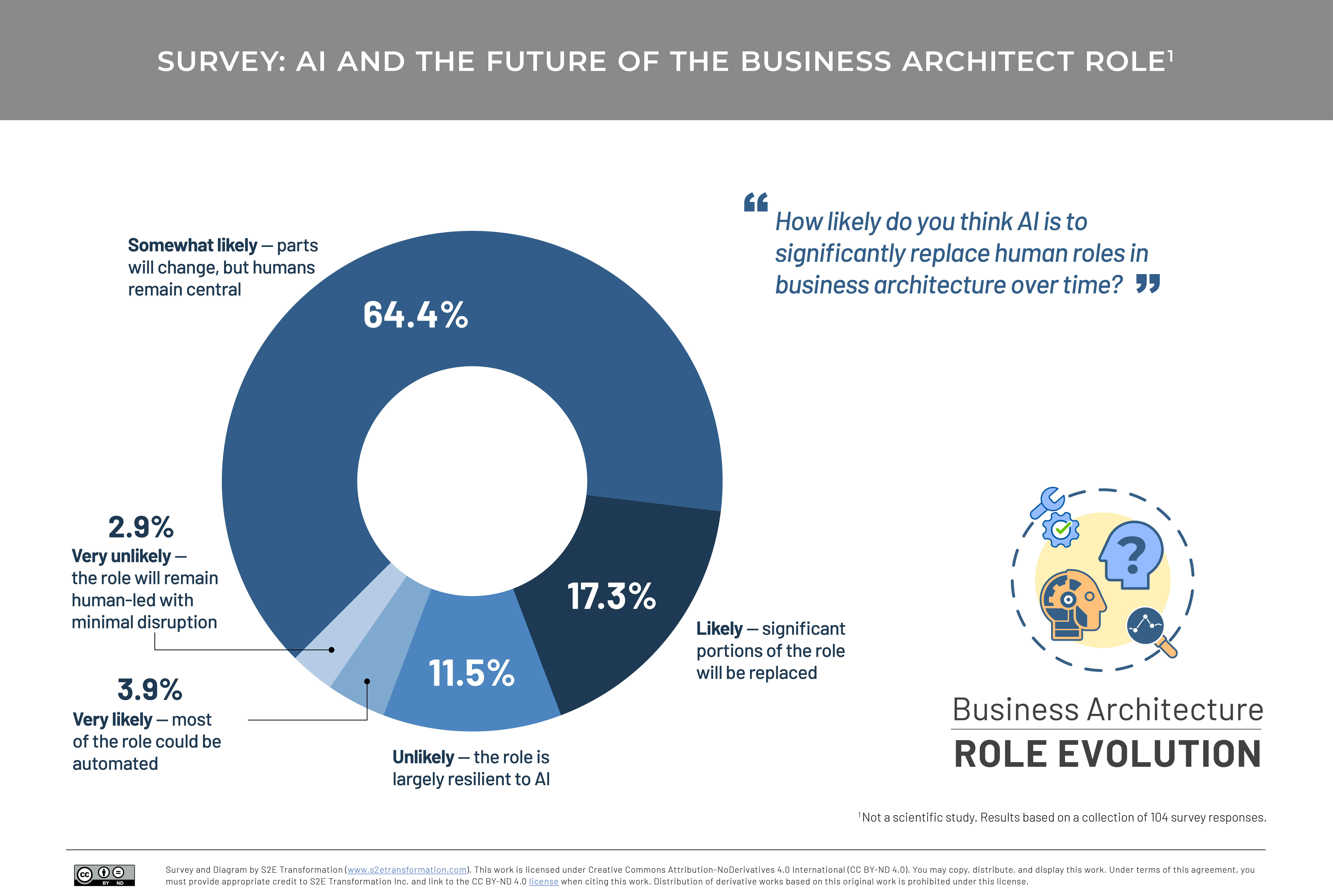
AI is viewed as a significant disruptor, but not a replacement for the human role in business architecture. Most respondents (64.4%) believe aspects of the role will change, with humans remaining central. Meanwhile, 17.3% expect significant portions to be replaced.
Comments from the respondents are below:
Very Unlikely
- Human centric design will continue to be led by humans, AI will advance repetitive tasks that enable capabilities and value stream to avoid or highlight bottlenecks, enabling a new business pace and therefore competitive advance when implemented.
- Areas such as governance and product pricing impact prior and post AI will need human assessment, without human intervention the ability to meet strategic market initiatives may hinder market product pricing and lead to a failed market entrance. Governance should also retain human oversight for national, regional and global compliance where varied requirements may need to be blended to meet all levels of compliance.
Unlikely
- If anything it will allow greater engagement because mundane tasks can be automated allowing more time for simultaneous engagement about more than one strategy or objective at one time. Each business architect will ne more productive.
- Business architecture requires too many soft skills
- New tools, quicker insights, human led
- I expect AI to significantly change how Business Architecture is practiced. Research, synthesis, documentation, modelling, pattern recognition and scenario exploration are all areas where AI can increasingly augment – and in some cases automate – portions of the work. I am less convinced that this translates into significant replacement of the human role. For me, the greatest value of Business Architecture is not producing the artifacts. It is helping an organization understand itself: surfacing assumptions, reconciling different perspectives, interpreting incomplete evidence, exposing dependencies and trade-offs, and strengthening the understanding from which strategic choices are made. Those activities rely heavily on context, inquiry, relationships and judgment. AI may therefore automate more of the mechanics of Business Architecture while allowing Business Architects to concentrate more of their effort on the parts of the profession where human contribution creates the greatest value. So I expect significant disruption to how the role is performed, without necessarily expecting significant replacement of the role itself.
Somewhat Likely
- I believe that a good business architecture practice will always need a human touch; someone to decide what to automate and what needs empathy, imagination and contextual understanding instead.
- AI doesn't build trusted relationships and read the room of human executives. AI will replace a lot of heads down analysis and synthesis work, and automate a lot of architectural modeling labor.
- I think that a foundation in business architecture is about human interaction and communication to agree on key principles and delivery business value. It can not today be replaced by AI.
- There is organizational context, the relationships and the know-how that will be difficult to replace.
- Business architecture is about strategy, key business decisions. AI will augment BA practice, not totally replace it.
- Architect role is very much about the soft stuff including influencing stakeholders, change management, strategic alignment etc. that can hardly be automated. Off course lot of modelling tasks, analysis tasks, etc. can be automated and will catapult the role into more of an advisory role including the strategic part.
- AI could absorb much of the objective work - documentation, modeling, and data management, so there may be fewer architects needed for these specific activities. However, architects who know how to direct AI, interpret its output, and connect strategy to technology will become even more valuable.
- I think the role will be resilient and but will need to change. Because the shape of the organization and work in general is changing. The cross-functional nature of business architect role will be a huge asset in this transformation. Having said that - While staying human-centered - This role needs to account for the hybrid nature of Humans & AI making decisions (strategic and operational) in a business. Soft skills such as collaboration, communication and structured skills like framework-based architecture need to re-align to thrive in a container where both humans & AI co-exist (as decision-makers, as stakeholders, as task owners, as role peers) to bring value towards critical differentiators (trust,…) and ultimately towards specific business outcomes.
- AI will amplify the role but the traditional BA that produces artefacts is at risk. As organisations transform and adapt, business architects will have to do the same. I expect the role will get even more strategic, more complex and higher stakes with fewer people doing it. Over the next 3 years, the focus will be on redesigning how work gets done and executing change; then on decision architecture, autonomy and governance, then ultimately on control, orchestration and shaping adaptive organisations.
- AI is likely to automate much of the analysis and modelling in business architecture, but not the need for human judgement. I see the role shifting towards strategic thinking, decision-making and influence rather than disappearing.
- AI is like having a very efficient and effective intern. You may be relieved of the grunt work and you’ll get a lot more work done but that just provides time to focus on more value-added engagement and thinking.
- Business architectural structured conceptualization of upcoming transformative projects, getting the desires from business, which can't formulate their needs in an organized, structured way - is a very human task. Reference to frameworks and patterns may be automated.
- I supposed it depends on the time horizon we’re talking about. I believe maintaining a knowledgebase, running analytics, and visualizing the architecture will be replaced in the next 3-5 years if not sooner, but the critical thinking and application of business context to the architecture will not be.
- At this point in time and 3-5 years out this is how I would score AI. It will help Business Architects to be more thorough to analyse more information than in the past.
- Maintaining the architectural artifacts is a very obvious first step here, as well as providing capability assessments, I do believe the human will maintain judgement calls here (at least in the smart organizations), capability-based planning will likely be a place where AI recommends, and humans edit, verify and decide
- Companies are understanding the "human roles" can't be switched to AI the way they were promised by Big Tech. This might be one of the best selling pitches in history. It's already not delivering the value. The pendulum will come back to center and AI will be a valuable tool to supplement the human value.
- Using even a local LLM for your knowledgebase wont work until we know the essence of business. Vocabulary based knowledgebases continue to struggle.
- AI is not there yet but it might. It will always need a business architect to direct things and sense check.
- Like any technology it will start by assisting and as trust and capabilities grow it will do more. Big concern about entry level roles that allow people to gain experience. These are the ones disrupted first.
- AI accelerates the business architect’s time to value delivery. It doesn’t replace it.
- With LLMs being able to leverage BizArch concepts and strategies to build deliverables, I think that development of these outputs will become automated. However, humans will play a central role in architecting business outcomes while AI plays a supporting role.
- Business Architecture roles will require AI specialty and a deep understanding of best practice for AI and automation transformation.
- What I have already seen, and expect to continue at scale, is AI making mappings and insight brainstorming significantly faster for Business Architects. That is paired directly though with overhwhelming evidence of the need for human review of those insights and applied expertise for how those insights should be put to action in the specific environment of your organization. We'll also need to play a significant role as Business Architects in helping our organizations make sense of AI investments, and draw stronger clarity as to what top level, core business capabilities are being advanced by which underlying, enabling AI capabilities.
- Business Architecture is both technical and an art. AI is a great tool we need to use more of. But the human component remains.
- I believe that a major part of business architecture is about human communication, AI might take over the technical role however, the human side won’t fade away.
- It’s more about knowing how to use AI to create impact quicker and with impact as a business architect.
- In my opinion AI will not replace, it assists, and potentially could accelerate the value and impact.
- My company built an Agent that uses stakeholder survey responses and dept. documents to evaluate and suggest what its business capabilities are. I use it like I would use industry jumpstart BCM from the Guild. It doesn’t dramatically speed up BCM identification, but it does help.
- Business Architecture is irrelevant in the AI era
Likely
- I believe as strategies and policies are defined, AI will be able to make connections between the new opportunities and demand through the capabilities, portfolio resources, and cost, and make the connections better and faster than a human could do. The output will be the architecture options, benefits, risks, and considerations based on what it knows about the business today and what their future plans are. Humans will be verifying the work and output as input into demand prioritization and product management.
- I choose likely because I've done quite a bit of research on the ability and requirements of language models and find that parts of designing and continuously refining the business and enterprise architecture can be produced from an AI model. The dependency and constraints to getting to a "likely" point include agreed upon semantic layer, data integrity and availability, and a continuous-timely feedback loop. In my view, business architects will play a dual role in the future specifically, maintaining the semantic model as defined by an agreed upon metamodel and guiding executives through decision making based on current and simulated target state business and operating models.
- Building out capability models and documenting how they should be deployed to achieve business goals, takes hours instead of weeks. Still requires human review and adjusting. Same applies to value streams.
- If most don’t understand the discipline and role of Business Architecture, then these same people will blindly accept what AI returns. So yes, for not just Business Architecture, but many roles.
Very Likely
It’s not when, it’s how roles will be automated. It’s not a surprise anymore.