Strategy Execution

Strategy Execution: What It Takes to Make Great Transformations

Effective strategy execution gives organizations the capacity to adapt and change, and it lies at the heart of successful transformations. This article describes what successful strategy execution looks like and how to move into action on the ideas.
Article

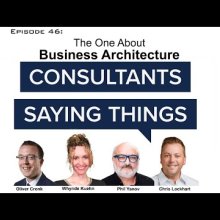
Consultants Saying Things About Business Architecture

In this episode, the Consultants Saying Things cast (Chris Lockhart, Phil Yanov, Oliver Cronk, and Whynde Kuehn), unpack business architecture including:
- What the heck IS Business Architecture anyway?
- How is it practiced? What are the methods and frameworks?
- What benefits does it provide? Who in the company should care?
- What are good examples of Business Architecture practice? What are bad ones?
- How does Business Architecture relate to Enterprise Architecture?
- How can you, yes YOU, get started in Business Architecture either as an employee in a company or as a consultant?
Video
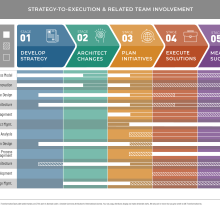
diagram showing Strategy-to-Execution Related Team Involvement

Strategy To Execution & Related Team Involvement

Downloadable Media
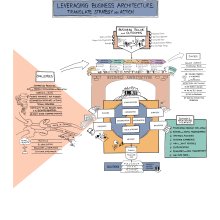
Detailed illustration showing graphic recording style for business architecture concepts

Leveraging Business Architecture to Translate Strategy Into Action (graphic recording version)

Downloadable Media

The Strategy Execution Metanoia: A New Approach for Translating Strategy Into Action With Business Architecture

In today’s highly competitive business environment where constant change is the new normal, the imperative for unified business direction has never been more important. Yet all-too-many enterprises have siloed business practices. These isolated business units, product lines, or other organizational constructs hamstring strategic execution that in turn leads to sub-optimal customer experiences, expensive redundancy, increased time to market and reduced competitiveness. What if strategy execution were approached from an enterprise perspective instead of in silos? This essential white paper explores business architecture as a means to integrated business direction that is collectively architected, prioritized and planned from a business-driven, top-down approach. Original Publish Date: 30 April 2017
Article


Designing AI Strategy: Connecting Technology to Business Value

The article describes how to design an AI strategy that is grounded in real business value and serves as a catalyst for organizations to rethink how they execute strategy altogether, with a more intentional, cohesive, integrated way of working across the organization.
Article

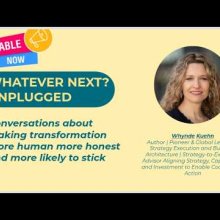
Whatever Next? Unplugged: Human First, Not Human After Thought

Lisa Woodall and Whynde Kuehn explore a sweeping set of discussion topics circling around the fact that transformation has a humanity problem, and what we can do about it.

They explore the growing tension between technology-led transformation and the human experience of change; the gap between strategy and execution and why organisations still struggle to make transformation stick; how capabilities, architecture, and human-centred design can work together to create more meaningful change; how to move beyond AI hype and technical delivery into the deeper questions: What kind of organisations are we really creating? Why is the human side of transformation still treated as an afterthought?; and can AI help us build more fulfilling and creative workplaces rather than simply replacing people?
Video

BoldAgendas: From Strategy to Structure

Mimi Brooks and Whynde Kuehn unpack how organizations still default to technology-first thinking, the role of a clear business blueprint in grounding decisions, and how business architecture helps connect strategy to execution through capabilities, value streams, and operating models.

In a landscape increasingly shaped by agentic systems influencing decisions and workflows, Mimi and Whynde explore how governance, control, and decision rights are becoming a central part of enterprise architecture.
Video

Cohesion: Connected Transformation by Design

This article summarizes key insights from global thought leaders Whynde Kuehn, Roger Burlton, and Doug Kirkpatrick in the December 2025 Digital Dialog. They explore the concept of cohesion, how it benefits organizations, practical steps to create a cohesive organization, and the art of possible.
Article

Transforming as an Enterprise

Transformation requires people across an entire organization to come together as an enterprise. We must not only succeed in our individual roles but also take ownership for the shared goals and outcomes for the organization as a whole. Establishing the intent to become a capability driven organization is an effective way to shift from siloed to enterprise thinking. This approach offers a simple yet effective way to institutionalize the type of holistic, systemic, and interconnected thinking that is essential for transformation.
Article