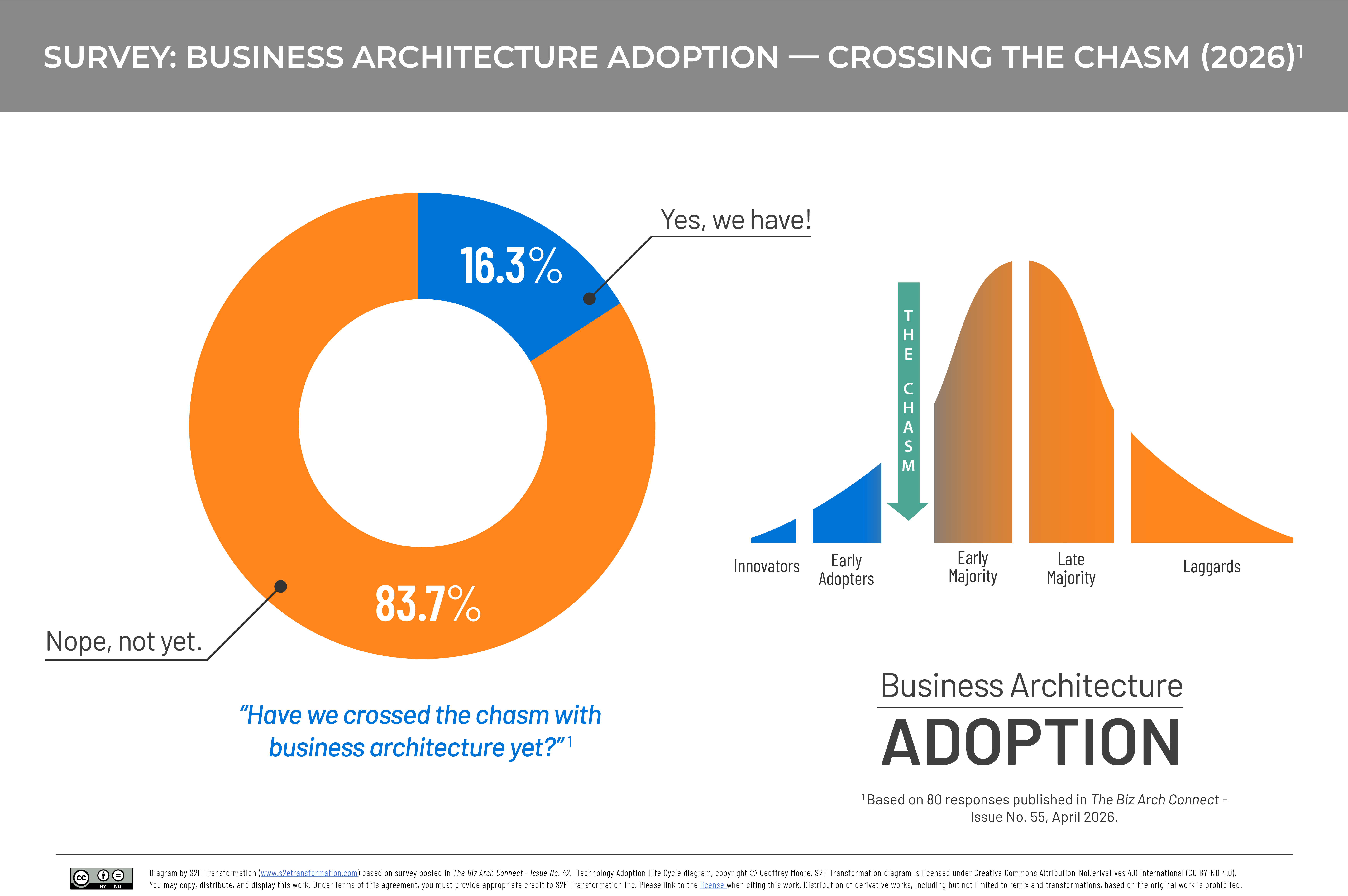
The results are in for the 2026 survey. Collectively, business architects do not believe that business architecture has crossed the chasm.
This 2026 survey reflects 83.7% of respondents believing business architecture has not crossed the chasm. The results are about the same compared to previous years. The 2024 survey revealed that 84.1% of the respondents did not think business architecture had crossed the chasm. In 2023 that percentage was 79.4%, in 2022, 79.5%, and in 2021, it was 81%.
Here is a selection of insightful comments from the respondents:
- I think many have crossed the chasm, but still others are still in the Early Adopters phase.
- Depends on the maturity of sectors, technologies.
- Every single business needs business architecture - it's such a critical function to have. When you look at all the different ways you can apply it, it just makes sense, but what perhaps is one of the most meaningful ways is the strategy to execution link it brings and all the tools we have to help bridge the two together.
- I feel that with the amount of people that submitted to speak at the summit, the number of industries representing the business architecture community, and the quality of the work being done by community volunteers and as shown through the quality of the presentations at the summit, I feel that as a global business architecture community we have jumped the chasm.
- I generally see larger organisations such as banks and insurance firms successfully using business architecture. They are definitely the early majority.
- As a discipline, business architecture is steadily becoming more and more prominent in helping the journey from Strategy to Execution but the onus is still on business architecture to prove its value first before being allowed to play a critical role. The opportunity is given but many times, business architects spend time prove their value first before they are given the keys to do actual work. Therefore, we still have some way to go!
- Once more mid-size organisations move over the chasm then yes, we have crossed the chasm.
- I feel that the context varies significantly from country to country. In the Japanese context, there is a complete lack of practical application, and it is not even widely recognised. In Japan, we are still at the stage where we are earnestly trying to understand the “why.”
- We are yet to overcome the challenge of successfully quantifying and articulating the value of business architecture to business leaders, relative to other architecture disciplines.
- Unfortunately business architecture is still not tied to measurable business outcomes at scale.
- I believe business architecture still requires significant promotion, as decision-makers often perceive it as overly complex and struggle to see its concrete value. The persistent confusion between business architecture, enterprise architecture, and IT, combined with the proliferation of competing frameworks such as Lean, SAFe, and Design Thinking, suffocates the practice and crowds it out of organizational attention. The chasm hasn’t been crossed yet, but the discipline has never been better positioned to do so. The rise of AI is an opportunity that will demonstrate that leaders need a clear practice to align capabilities and support informed decision-making.
- Limited profile and much confusion among executives that claim to know about business architecture.
- I think a lot of progress has to be made to cross the chasm for business architecture as a strategic discipline. The Strategy department slows down this progress in many ways. As well as the lack of mastering executive communication competencies by the business architects.
- To truly cross the chasm, I think it requires a shift in enterprise mindset from 'solution-first' planning to a capability-based lens that provides decision-makers with quantifiable clarity on feasibility and ROI during the initial business case phase. Until business architecture is the default starting point for all major transformations, I see it remaining in the chasm.
- While business architecture has established robust frameworks and a strong community of practitioners (Innovators/Early Adopters), I feel we haven't fully 'crossed the chasm' into the Early Majority. In many large organizations, business architecture is still fighting to be recognized as a strategic partner rather than a downstream technical requirement.
- We are still in a phase where insight is based upon a few persons. Not a part of the everyday routines of the company, and a part of the mindset of the business management.
- Our large UK government department had 19 business architects two years ago. Now we have 7. The organisation does not value the function.
- With all of the layoffs and fear of more, companies seem to not be investing in specialty roles. They justify positions by widget production.
- I work in consulting, not a lot of clients and peers know about business architecture, even when they may do related work or try to solve related problems.
- The goals of the discipline are usually being done by others in the organization using different techniques.
- Even early adopters seem confused about what it is. Most articulations are around operating model level stuff and either business focused solution architects or business analysts with a fancier title.